
Our Models:
hydrogels and scaffolds
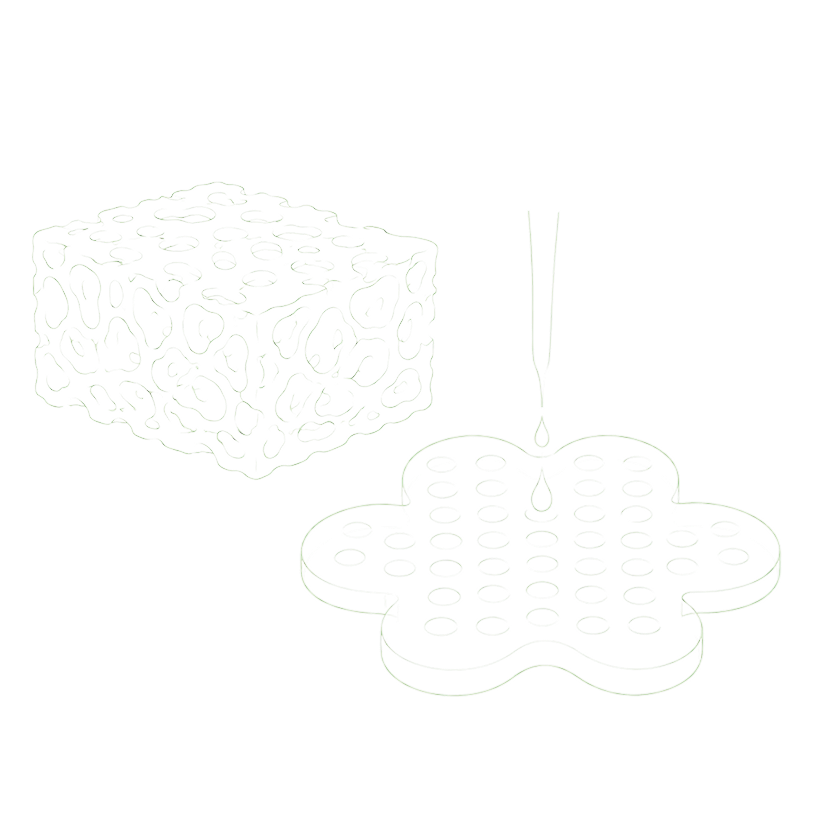
Silk4B in vitro 3D bone marrow models can be created either as hydrogels or scaffolds. They are very similar in their capabilities and offer high translational relevance, but do have slight differences. Silk hydrogels are suitable from low throughput to high throughput experiments that can fit into automated workflows. Silk scaffolds fit low to medium throughput experiments and allow to create the highest bone marrow model complexity including perfusion capabilities.
Home› Our models › Silk Hydrogels and Silk Scaffolds
Our silk-based in vitro 3D bone marrow models can be either hydrogels or scaffolds. Both provide the same physical properties as the in vivo bone marrow matrix. These hydrogels and scaffolds are seeded with the cells of interest and both allow the study of single or multiple cell types within the bone marrow niche. Hydrogels come as a liquid material and the cell suspension is added to the hydrogel material and mixed, followed by dispensing the mix into a desired shape and then cross-linking. Scaffolds are porous materials and are seeded with cells by pipetting or perfusing a cell suspension into the scaffold.
Both allow full differentiation and maturation of blood cell types (thrombopoiesis, erythropoiesis) and multi cell type interactions. Scaffolds have the advantage of the porous architecture which allows the most complex cellular and niche interaction.
Scaffolds can even be perfused mimicking blood flow and mature cell type release into the blood. Hydrogels offer scale flexibility and fit high throughput experimental design allowing to test myriad of conditions at once (from varied physical stiffness levels, multiple treatments at different concentrations, cells from multiple donors, and different differentiation protocols).
The hydrogels and scaffolds are complementary setups delivering high biological relevance along a complexity vs scale continuum. Early experiments requiring standardized and scalable biological readouts can be done in hydrogels, and subsequent experiments requiring sophisticated spatial organization and complex niche biology are best in scaffolds.
Silk Scaffolds
Our scaffold was the first silk-based 3D bone marrow model and is still the matrix that allows the most complex bone marrow niche creation in vitro. It has the same physical stiffness properties and sponge type structure like the bone marrow. It can be coated with extracellular matrix proteins like fibronectin (a matrix protein present in the native bone marrow niche). It also can be seeded with various cells, like the stromal cells that are present in the bone marrow and secrete extracellular matrix themselves. The seeding can be done sequentially or simultaneously. It can be placed in a perfusion chamber that allows seeding of cells or collecting mature differentiated cells via perfusion (with the possibility of several chambers connected in parallel to the pump).
It also has the advantage of various forms of imaging to dissect cell-cell and cell-matrix interactions within the bone marrow niche from live imaging, to immunohistochemistry, to scanning and transmission electron microscopy.
Silk Hydrogels
Our hydrogels were developed to allow for scalable use of our silk-based 3D bone marrow model. Currently other commercial bioinks do not have the necessary softness to emulate the physical properties of the bone marrow. They are orders of magnitude higher in stiffness compared to bone marrow. Our hydrogels, just like our scaffold, have the exact physical softness of the bone marrow.
We have created 3 formulations that address the specific needs and capabilities of academic and pharma R&D teams.
In all three models, cells are easily mixed directly inside the liquid hydrogel at physiological 37°C, are extruded into the shape of interest, and then physiological ionic cross-linking stabilizes the 3D structure-supporting pattern.
The structure is very soft and malleable. It is also transparent enough to allow live microscopy (including phase contrast) as well as immunohistochemistry. Cells can easily be retrieved later with a special retrieval solution that dissolves the matrix while being gentle on the cells. The cells can be used in downstream applications from FACS to further co-culture, functional assays, RNA sequencing, proteomics and biochemistry. The silk hydrogels also allow distribution of drugs and other media components easily, as well as pre-loading with components that allow biological readouts.
SilkInk™
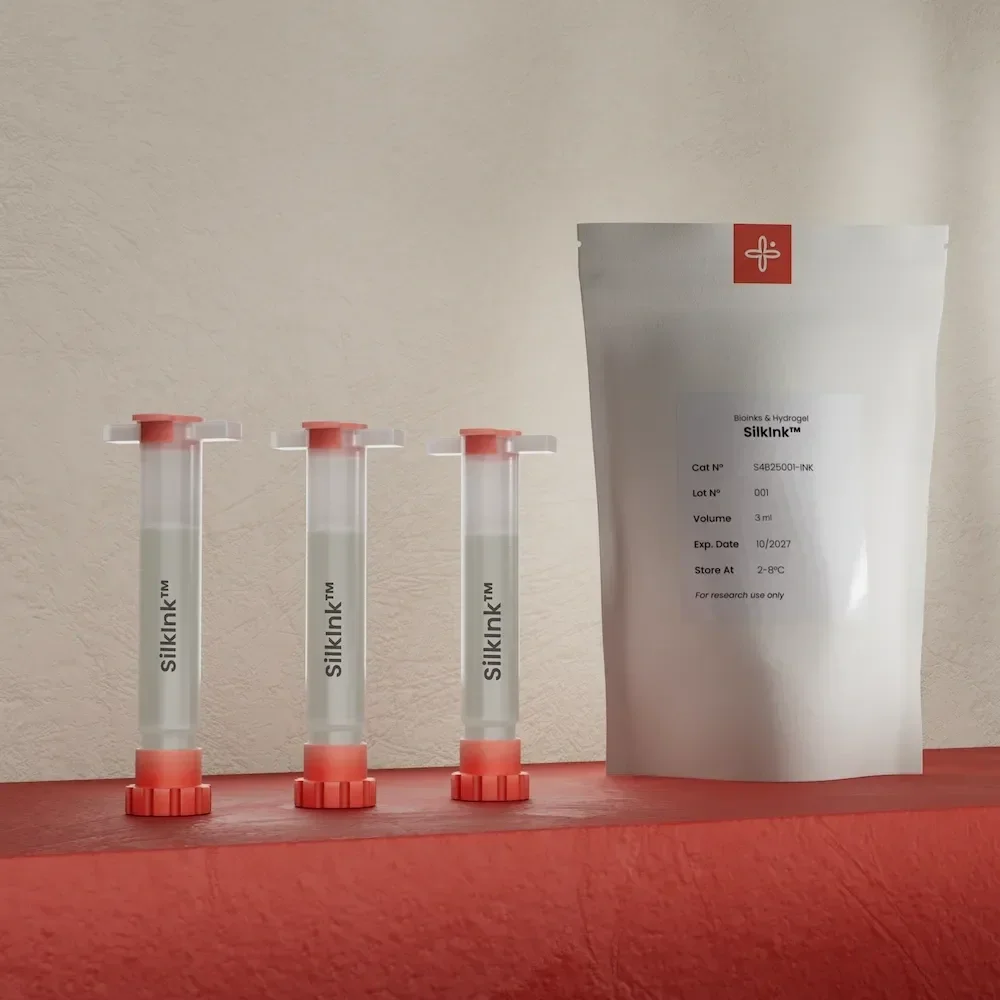
SilkInk is the model that works with 3D bioprinters, allowing bioprinting of our 3D bone marrow model in a variety of shapes, volumes and cell numbers, and from low to high throughput in formats that fit into downstream automated workflows.
SilkThermo™
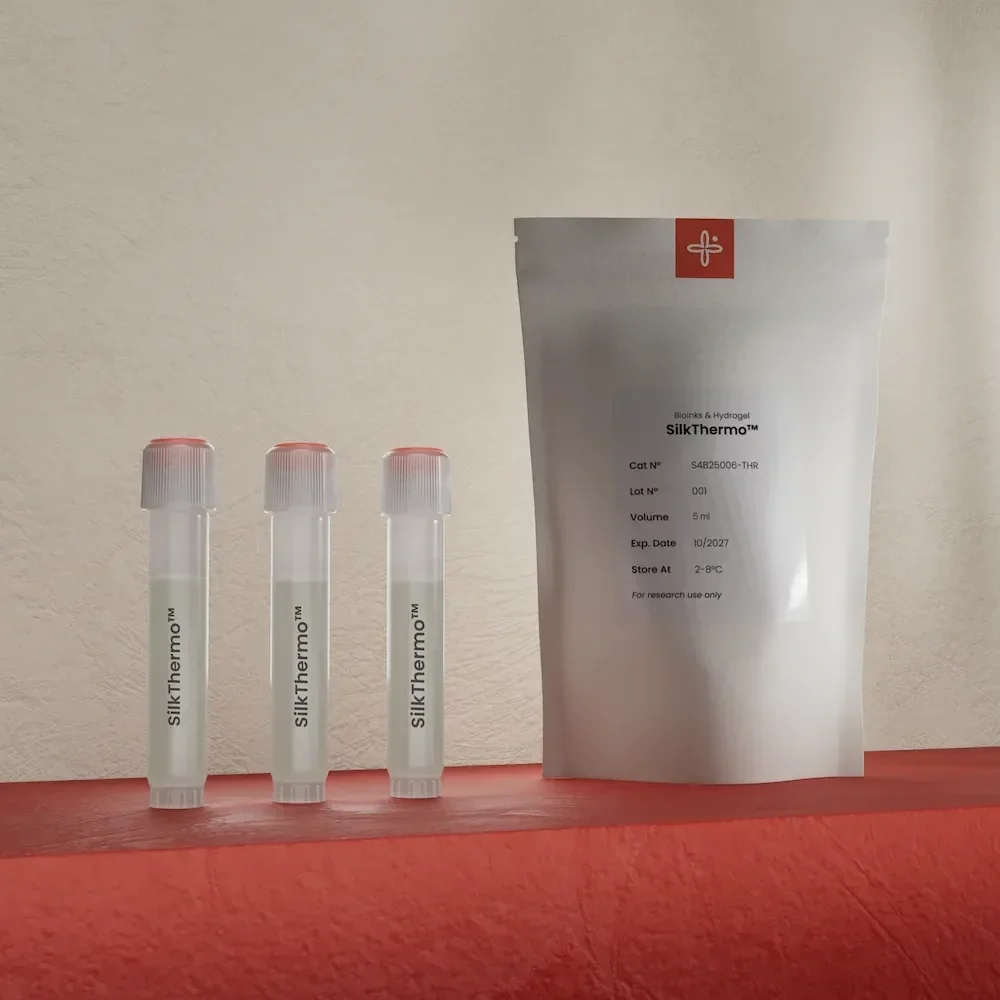
SilkThermo is identical in its properties to SilkInk, but is adapted for manual use and extrusion into provided molds. It is best used by researchers who don’t have easy access to the bioprinter and don’t need high throughput setups.
SilkTune™
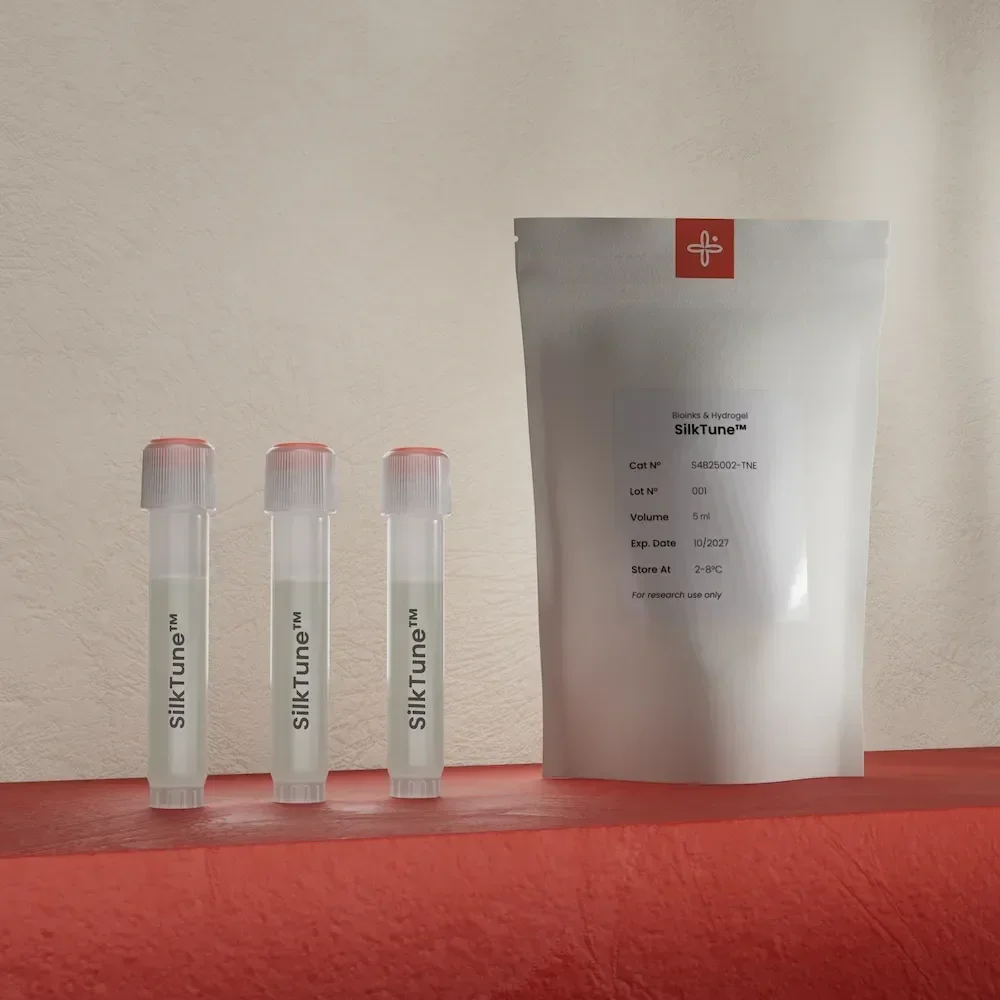
SilkTune is different from SilkInk and SilkThermo in that it has modified physical stiffness properties. SilkTune is used to recreate a diseased-like bone marrow situations where the stiffness of the bone marrow niche changes from normal. It is used when studying malignancies and the effects of changes in physical properties of bone marrow.
References
BLOOD – 2015
BIOMATERIALS – 2017
Modular flow chamber for engineering bone marrow architecture and function
BIOMATERIALS – 2018
Multi-channel silk sponge mimicking bone marrow vascular niche for platelet production
https://pubmed.ncbi.nlm.nih.gov/29920404/
ADV. SCI – 2024
BLOOD ADV. – 2025
SMALL – 2026