
Relevance in drug discovery
The high translational relevance to human biology, biological complexity, scalability and reproducibility make our in vitro 3D bone marrow models an essential tool in improving outcomes during drug discovery.
Home › Our models › Relevance in drug discovery
Our in vitro 3D bone marrow models improve drug-discovery
Have high translational relevance to human biology
Faithfully mimic the physical properties of the bone marrow niche, including malignancies with altered bone marrow matrix properties
Allow cell maintenance (HSPCs, leukocytes) and cellular differentiation (thrombopoiesis, erythropoiesis)
Offer compatibility with different cell sources for differentiation, including sensitive and valuable patient derived cells
Allow studies of malignant leukemia cells
Allow multiple cell type co-culture, including mixing healthy and diseased cells to elucidate cell type specific contribution to disease
Show healthier molecular signature of cells compared to cells in 2D culture
Are biocompatible and non-thrombogenic
Are reproducible and scalable
Are validated in peer-reviewed publications
Are cost and time effective
On-target studies in hematology
The ability to mimic in vivo human bone marrow in our studies allows to cover early drug discovery from scientific mechanism elucidation to target ID, lead ID and optimization, and pre-clinical work.
The high translational relevance of our models was clinically validated. Our models predicted divergent patient cell response to eltrombopag at clinical concentrations that correlated with corresponding patient clinical response, R² = 0.78.
Studies on JAK2V617F MPN have shown that our 3D bone marrow models work with biologics that can affect phenotypes.
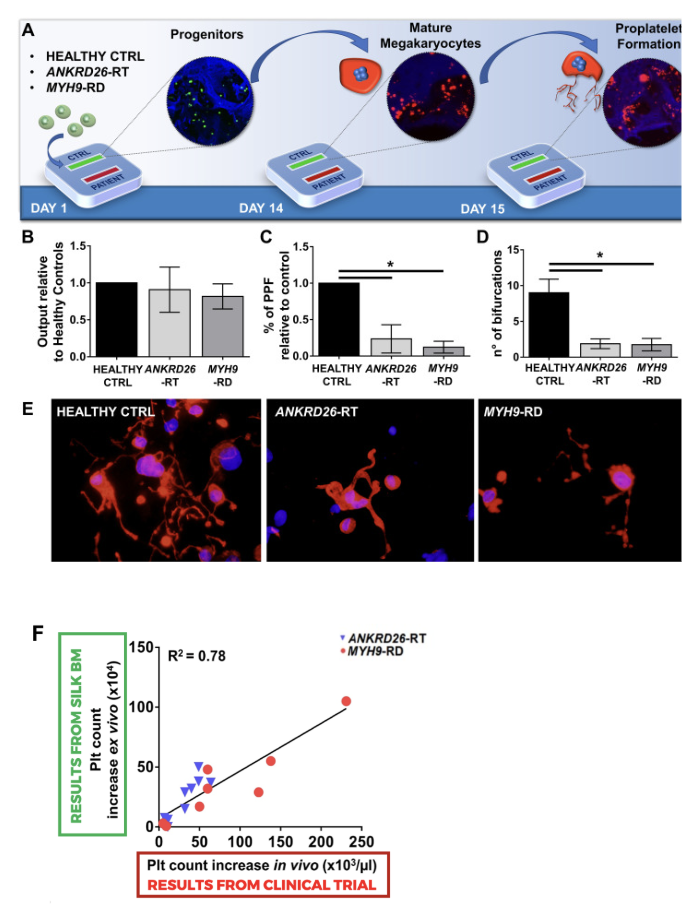
(A) Megakaryocytes (MKs) were differentiated from healthy controls and MYH9-RD and ANKRD26-RT patients and cultured into the bone marrow device in presence of 10 ng/mL TPO.
(B) Output of CD41+CD42b+ megakaryocyte at the end of differentiation relative to healthy controls shows no statistical difference
(C,D) Percentage of proplatelet formation relative to healthy controls and the number of proplatelet bifurcation per single MK in healthy controls and patients show statistically significant differences (*p<0.01) showing that platelet formation from MKs is affected in these patients. All results are presented as mean ± SD.
(E) Representative immunofluorescence staining of proplatelet structure (red=β1-tubulin; blue = nuclei).
(F) There is a strong correlation (R² = 0.78) between the in vivo patient response to eltrombopag in the clinical trial and the in vitro response of patient cells in our 3D bone marrow models treated with same concentration of eltrombopag as patients in vivo. MYH9–RD patients tend to respond stronger to eltrombopag than ANKRD26-RT patients.
Off-target studies in all other conditions
Bone marrow safety issues are a significant reason for drug failures in clinical trials, costing millions of Euros to companies and no improvement to patients’ lives. The most well known disease area for bone marrow safety issues is oncology; however all disease areas would benefit from bone marrow models in drug discovery that are translationally relevant to human biology, cost-effective, and scalable. For example, in neurology, too many drugs have also failed clinical trials or were restricted/withdrawn after approval due to effects on bone marrow cells or hematopoiesis (e.g., felbamate in epilepsy - black box restricted, remoxipride in schizophrenia - withdrawn, metamizole in pain - banned in US, UK and many other countries, tozadenant in Parkinson’s - phase III discontinuation, Skysona gene therapy for cerebral adrenoleukodystrophy - approved with restrictions due to leukemia risk).
A major reason for these failures is that in vivo mouse models have enough biological differences from human hematopoiesis, while 2D liquid culture models of human cells have low biological relevance. Pre-clinical studies which predominantly use these models have lower chances to detect bone marrow safety issues of drug candidates prior to clinical trials. Non-human primates are biologically more relevant to humans; however are expensive, have significant legal paperwork and raise significant ethical concerns making them impractical to use during early drug discovery and lead optimization.
Our in vitro 3D bone marrow models are a scalable solution bringing translationally relevant human studies. They allow bone marrow safety to become operationally and financially feasible during early drug discovery. This can help save millions of Euros by potentially avoiding failed clinical trials due to hematological safety issues in patients and save time in drug discovery by allowing drug candidates with the lowest probability of bone marrow safety concerns to enter clinical trials.
In an undisclosed collaboration with a pharma client, our in vitro human based 3D bone marrow models have accurately identified a hematological safety concern for a neurological drug candidate that in vivo mouse models missed. The drug candidate failed clinical studies due to hematological safety issues.
References
SMALL – 2026
Thermo-Chemically Modified Silk Scaffolds Reveal Niche-Driven Regulation of Hematopoiesis and Fibrosis
ELIFE – 2021
Miniaturized 3D bone marrow tissue model to assess response to Thrombopoietin-receptor agonists in patients