
Our models: comparison and complementarity with other models
Silk4B in vitro 3D bone marrow models offer high translational relevance to human biology with the scalability of 2D liquid culture systems. It is also complementary with many existing models.
Home› Our models › Model comparison
Silk4B 3D bone marrow
Standard 2D liquid culture is fast and low-cost but structurally simple and translationally limited.
Organoid systems capture biological complexity at a steep experimental cost, considerable time and challenges with standardization.
Animal-based models capture native bone marrow biological complexity within the organism but are costly, time consuming, ethically fraught and in case of mouse models, often poor translational relevance to human biology.
Silk4B's silk-based 3D bone marrow models are built from human cells and faithfully recreate the 3D architecture, matrix physical properties, and cell-matrix and cell-cell interactions that define the native bone marrow niche. This allows the models to deliver in vitro translational value 2D culture cannot reach and human relevance that mouse in vivo models can lack. The models are also standardized and reproducible, operational easy to set up and image, fast and scalable as standard 2D workflows. They also result in lower reagent costs and personnel time savings compared even to 2D culture.
Silk4B’s 3D bone marrow physical stiffness is tuned to match native bone marrow — around 1 kPa, within the marrow's physiological 0.1–10 kPa range, a property most 3D culture matrices, including conventional bioprinting inks, don't replicate. Our 3D bone marrow models work across human cell sources, including patient-derived HSPCs, cord blood, bone marrow biopsy material, cell lines, and iPSC-derived cells, and support precisely controlled co-culture of multiple cell types to build niche complexity deliberately rather than relying on self-organization. They work with mouse cells, too.
2D Liquid Culture
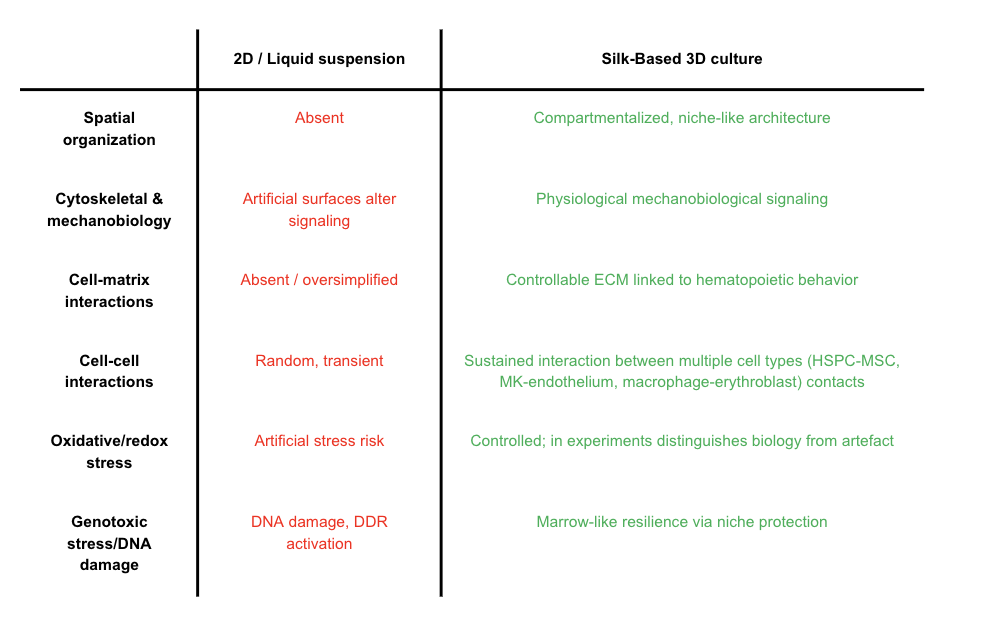
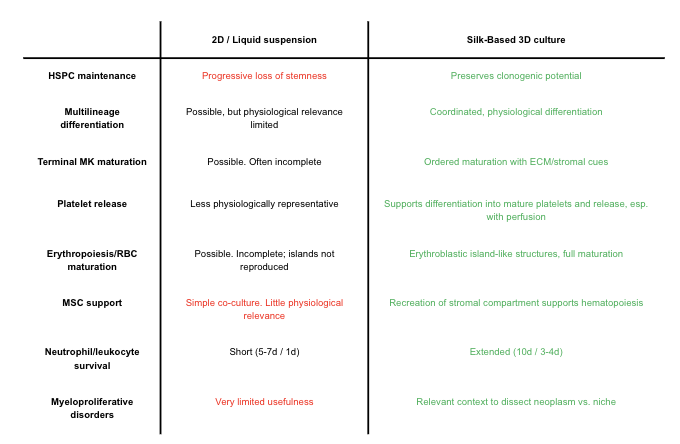
2D culture remains the default for basic hematopoietic work: inexpensive, fast to set up, easy to scale, and straightforward to image. Its limitation is structural, it can't reproduce the three-dimensional architecture or matrix interactions that define the niche. Removed from that niche, HSPCs activate stress-associated programs (including replication stress, DNA damage response, and redox stress) and typically lose stemness capacity under standard 2D conditions over time.
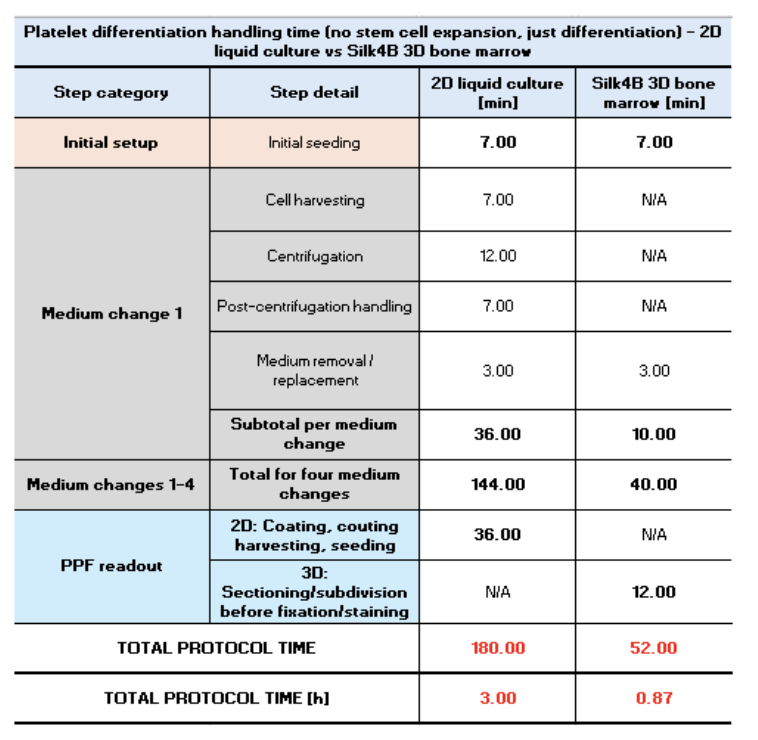
Silk4B’s in vitro 3D models allow for 2D culture's simplicity and throughput while adding the 3D niche architecture and matrix support that mimics better the in vivo bone marrow niche. Thus, our 3D bone marrow models preserve primary HSPCs and other cells, allow for more mature and functional cell differentiation with higher yields. Additionally, due to the 3D architecture and a more native-like environment for cells, our 3D bone marrow models use meaningfully fewer reagents (media, cytokines) and less hands-on personnel time per experiment.

Comparison of reagent costs during platelet differentiation in 2D liquid culture and Silk4B’s 3D bone marrow models.
Comparison of personnel time during platelet differentiation in 2D liquid culture and Silk4B’s 3D bone marrow models. 2D requires cell recovery; 3D requires only simplified medium replacement. N/A - not applicable step for that
Organoids
Self-organizing organoid systems can achieve striking spontaneous multicellular complexity and remain a valuable tool for capturing emergent niche biology. That same self-organizing nature makes them harder to standardize and control precisely, typically slower to establish, and more expensive. Silk4B 3D bone marrow models take an engineered approach of trading some of that spontaneous complexity for speed, reproducibility, and control over composition and format. Multiple cell types can be seeded in a defined sequence and ratio (e.g., stromal cells with HSPCs, megakaryocytes with endothelial cells, megakaryocytes with neutrophils, all of these cell types together), building niche complexity deliberately rather than waiting for it to emerge, with more complex combinations in active development.
Importantly, organoids and Silk4B 3D bone marrow models can be complementary with each other to answer biological questions and even to try Silk4B hydrogels as a supporting matrix during organoid development.
Mouse Models
Mouse models remain the standard for studying hematopoiesis in a living organism capturing multi-organ interactions, and long-term in vivo dynamics. Their central limitation is translational: mouse and human bone marrow biology diverge in meaningful ways, and studies are slow, low-throughput, and carry real ethical considerations. Silk4B’s 3D bone marrow models was developed around human cells, removing species-translation uncertainty. Also, as in vitro models, our 3D bone marrow models enable faster, more scalable studies.
Importantly, mouse models and our 3D bone marrow models are complementary, studies in both can ensure relevant biology is observed and in drug discovery on-target and off-target hematological effects are caught. Also, the platform also works with mouse cells, allowing to use valuable primary cells from mice modified for a particular biological or medical question and investigate biology with in vitro tools that are not accessible to in vivo studies (e.g., live bone marrow imaging, high throughput concentration studiest, etc).
Non-Human Primates
Non-human primate models offer the closest phylogenetic match to human physiology and, like mouse models, capture systemic biology unavailable in vitro. They are also the most costly, slowest, and most ethically constrained models in hematology research, limiting their use to late-stage or highly targeted studies. Silk4B’s 3D bone marrow model offers a human-relevant, scalable alternative for the earlier discovery and screening stages where NHP studies would be impractical. This makes the two model complementary along the drug discovery path