Applications
Hematopoietic stem and progenitor cells (HSPCs) in silk-based 3D bone marrow models
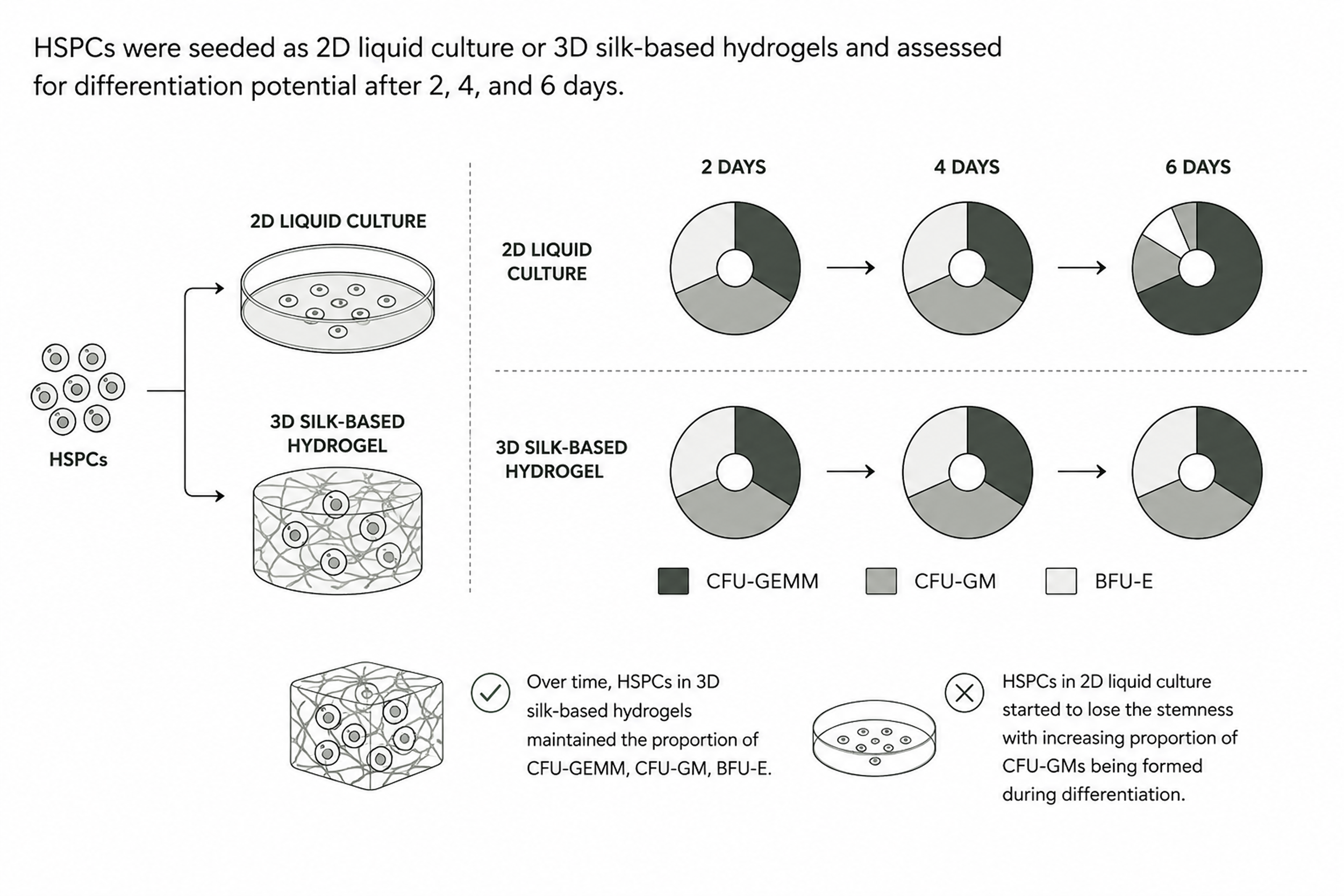
HSPCs seeded in our 3D bone marrow models have high survival rate, proliferate while maintaining their stemness and differentiation potential.
Home › Applications › Hematopoietic stem and progenitor cells
The bone marrow microenvironment regulates hematopoiesis through an integrated set of biochemical, structural, and mechanical cues that coordinate hematopoietic stem and progenitor cell (HSPC) maintenance, lineage commitment, and stress adaptation. Removed from their niche, HSPCs rapidly lose stem-cell function and activate stress-associated programs that distort cell identity and differentiation potential. Our in vitro 3D bone marrow models allow for high survival rate, proliferation and maintenance of stemness of HSPCs over time, preserving their differentiation potential into multiple lineages.
In contrast, when HSPCs are kept in 2D liquid culture they lose their stemness over time and activate cytoskeletal-tension and genome-surveillance programs characteristic of chronic stress, including pathways related to replication stress, DNA damage response, and redox stress. Our 3D bone marrow models work with primary HSPCs from mobilized peripheral blood, cord blood, or bone marrow biopsy, as well as differentiated ones from iPSCs.
HSPCs in Silk4B 3D bone marrow models
High cell survival
Maintenance of stemness and multipotent differentiation
Lower chronic cellular
stress than 2D culture
Works with HSPCs
from multiple sources