
Multiple cell types co-culture is possible in Silk4B’s 3D bone marrow models to increase complexity of the bone marrow niche. This allows ever closer mimicking the in vivo environment and methodical dissection of intracellular and intercellular pathways responsible for biological functions, disease pathology and potential drug targets.
Multiple cell types co-culture
Applications
Home › Applications › Co-culture
HSPCs and stromal cells.
We can culture stromal cells (MSCs, mesencymal stem cells) in both our 3D bone marrow models, scaffolds and hydrogels, and show that they deposit fibronectin around them. We can also sequentially seed stromal cells into our scaffolds, allowing for fibronectin deposition, followed by HSPC seeding.
Megakaryocytes (MKs) and endothelial cells.
Co-culture of MKs (HPSC differentiated in our model) with endothelial cells shows cells co-localize and results in increased platelet production.
Megakaryocytes (MKs) and neutrophils.
In our 3D bone marrow model, neutrophils are functional and participate in megakaryocyte emperipolesis resulting in increased platelet production. Furthermore, studies in our 3D bone marrow models using healthy and diseased megakaryocytes and neutrophils from patients with JAK2V617F myeloproliferative neoplasms were able to confirm defective neutrophil clearance via immune checkpoint CD24 as a cause in the disease.
HSPCs, MKs, endothelial cells, stromal cells.
It is also possible to co-culture several of these cell types together in our models. We are currently validating these models in detail. This will allow ever closer mimicking of the in vivo environment and methodical dissection of intracellular and intercellular pathways responsible for biological functions, disease pathology and potential drug targets
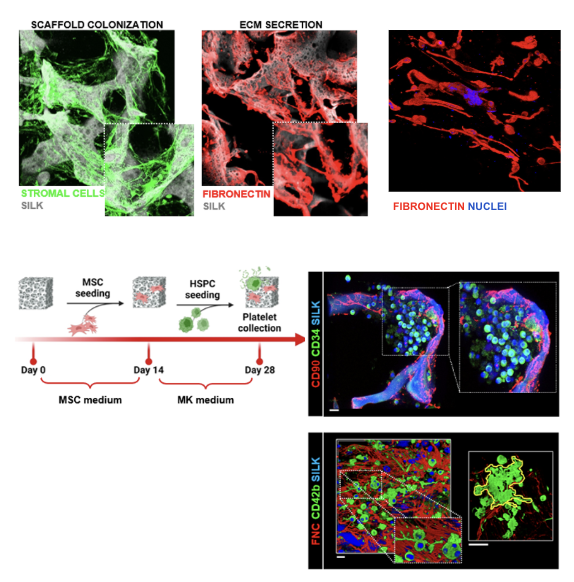
Top left and center: Stromal cells seeded on silk scaffold deposit fibronectin on the silk scaffold.
Top right: Stromal cells in silk hydrogels also deposit fibronectin around them.
Bottom: sequential seeding of stromal MSCs followed by HSPCs, and then megakaryocyte differentiation. Early in differentiation HSPCs (CD34+) colocalize with MSCs (CD90) and later MKs (CD42b) colocalize with fibronectin (FNC) deposited by the MSCs.
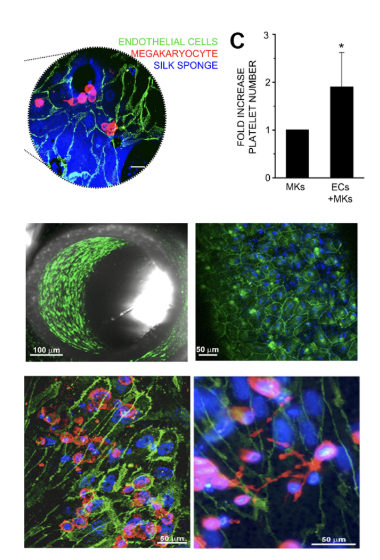
MK and endothelial co-culture in our scaffolds results in higher production of platelets.
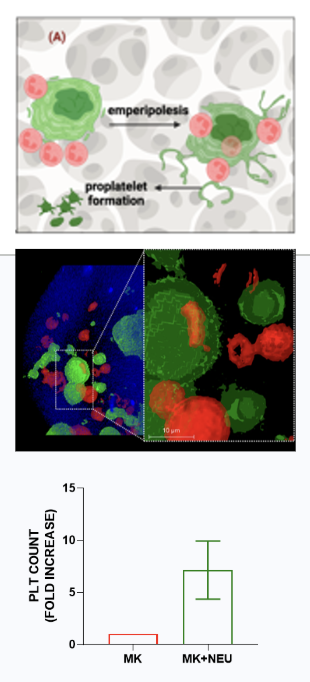
Neutrophil co-culture with megakaryocytes (MK) results in emperipolesis and higher platelet production